
Most Shopify store owners are constantly chasing traffic.
They run Facebook ads, test creatives, optimize landing pages, tweak product descriptions, and experiment with different funnels. All of these are valid strategies. But there’s one traffic source that quietly sits in the background—often ignored, rarely optimized, and massively underutilized.
That source is image SEO.
It doesn’t feel exciting. It doesn’t give instant results like ads. And because of that, most store owners overlook it completely. But the reality is, your product images have the potential to bring in consistent, high-intent, free traffic—if they are optimized properly.
And that’s where most stores are falling short.
Why Image SEO Matters More Than You Think
When people talk about SEO, they usually focus on keywords, blog content, backlinks, and product descriptions. Very few people talk about image SEO.
But here’s the thing—Google Image Search is huge.
Millions of users search visually every day. They are not typing long queries; they are looking for products, styles, and ideas through images.
And these users often have strong intent.
Someone searching for a product image is usually closer to making a decision than someone casually browsing text-based results. They know what they’re looking for—they just need to find the right option.
If your product image appears at that moment, you’re not just getting traffic—you’re getting relevant traffic.
This is what makes image SEO so powerful.
It’s not about volume alone. It’s about quality of intent.
The Scale of Missed Opportunity
Let’s break this down with a simple example.
If your store has 200 products and each product has 4 images, that’s 800 images.
That’s 800 potential entry points into your store.
Now imagine none of those images are optimized.
That’s 800 missed opportunities.
Multiply that across larger stores—500 products, 1000 products—and the gap becomes massive.
Most Shopify stores are sitting on hundreds or thousands of images that are doing absolutely nothing for their growth.
Not because they don’t have content—but because that content is not optimized.
Why Most Stores Ignore Image SEO
If image SEO is so valuable, why do most store owners ignore it?
The answer is simple: execution.
Understanding alt text is easy. Implementing it at scale is not.
Writing alt text for a few images is manageable. But writing it for hundreds or thousands of images quickly becomes a tedious, repetitive task.
It’s the kind of work that feels important but not urgent.
And anything that feels like that usually gets delayed.
Store owners start with good intentions. They update a few products, maybe optimize some images, and then stop halfway. The process feels too slow, too manual, and too time-consuming.
So it gets pushed aside.
Another issue is inconsistency.
Even when store owners try to optimize alt text, they don’t follow a clear structure. Some images get detailed descriptions, others get short ones, and some are left blank.
This lack of consistency weakens the overall impact.
Search engines prefer structured data. When your store follows a pattern, it becomes easier to understand and rank.
Without that structure, your SEO efforts become scattered.
What Good Alt Text Actually Looks Like
Before going further, it’s important to understand what effective alt text looks like.
Good alt text is not just a random description. It should be:
- Clear and descriptive
- Relevant to the product
- Keyword-aware but not stuffed
- Consistent across similar images
For example:
Instead of writing:
“image1” or “product photo”
You write:
“black leather wallet for men with zipper, premium design”
This gives search engines real context.
Now imagine applying this level of clarity across hundreds of images.
That’s where the real impact begins.
The Need for a System, Not a Task
The biggest mistake store owners make is treating alt text as a one-time task.
They think:
“I need to fix my alt text.”
But the better approach is:
“I need a system for alt text.”
Because this is not something you do once. It’s something that needs to scale with your store.
As you add new products, new images, new collections—you need a way to keep everything consistent without starting from scratch every time.
And this is where most manual approaches fail.
Manual work doesn’t scale.
Turning Image SEO Into a Scalable Process
To make image SEO effective, it needs to be:
- Fast
- Repeatable
- Consistent
- Scalable
This is exactly where bulk optimization changes everything.
Instead of editing images one by one, you apply a structured format across multiple images at once.
You define how your alt text should look, and then you apply that logic everywhere.
This removes the biggest barrier—time.
But more importantly, it introduces consistency.
How Bulk Alt Tag Optimizer Fits In
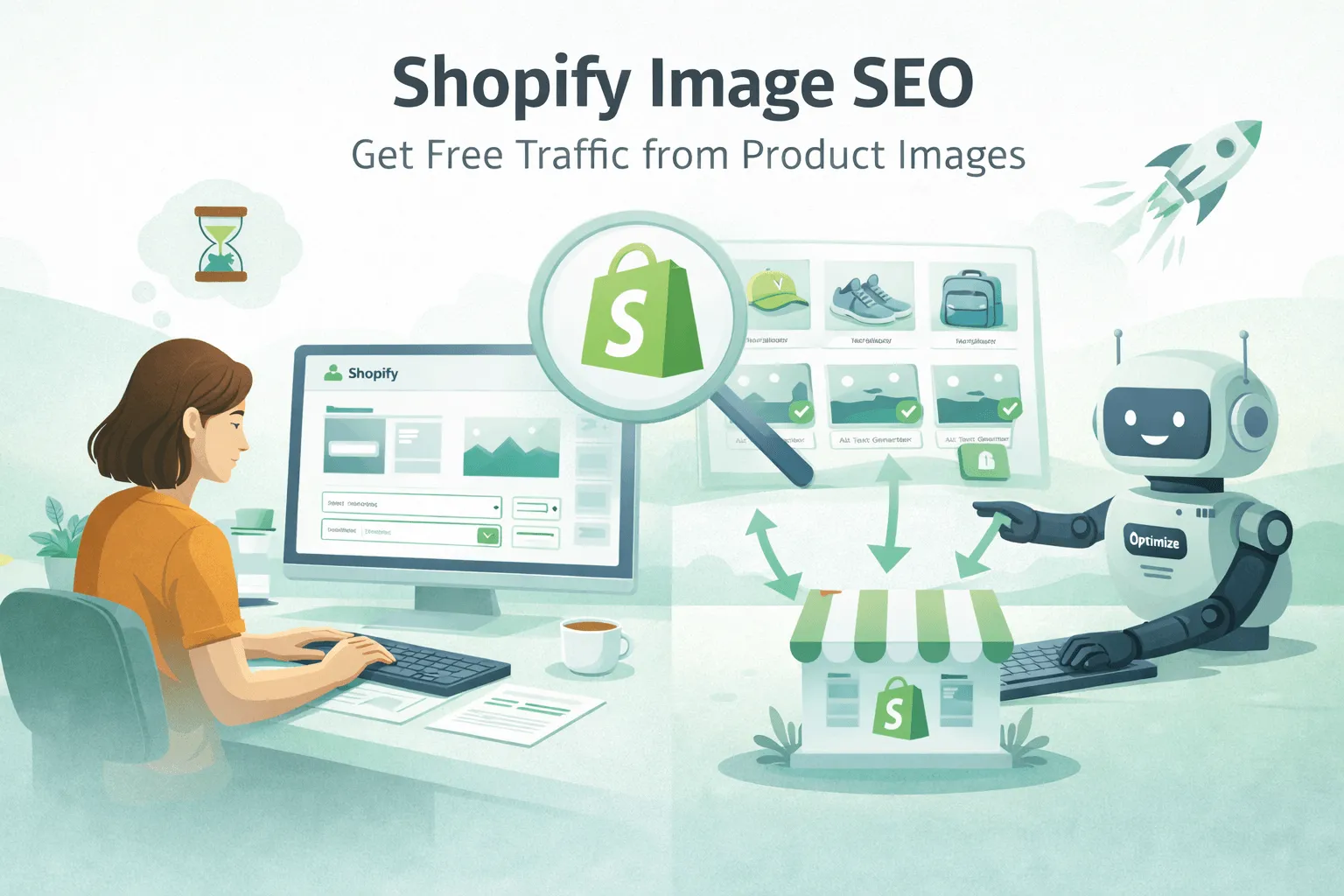
Bulk Alt Tag Optimizer is built specifically to solve this problem.
Instead of forcing you to go through each image manually, it allows you to update alt text across your store in bulk.
You can select multiple images—or even your entire store—and apply changes instantly.
This transforms a task that would normally take hours into something that takes minutes.
But speed is only part of the value.
The real advantage is the template system.
Instead of writing alt text manually, you can create a structured format using your existing product data.
For example:
- Product Title – Buy Online
- Product Title – Premium Quality
- Collection Name – Latest Design
Once you define this format, you can apply it across all selected images.
This ensures that every image follows the same pattern.
From an SEO perspective, this is extremely powerful.
Why Consistency Improves SEO Performance
Search engines don’t just look at individual pieces of content—they look at patterns.
When your store has consistent alt text, it creates a structured environment. Google can easily understand what your images represent, how they relate to your products, and how your content is organized.
This improves indexing.
Better indexing leads to better visibility.
And better visibility leads to more traffic.
Consistency also improves keyword alignment.
When your alt text follows a pattern, you’re reinforcing the same keywords across multiple images. This strengthens your overall SEO signals.
Instead of scattered efforts, you’re building a focused strategy.
Long-Term Impact of Image SEO
One of the biggest advantages of image SEO is that it compounds over time.
Unlike ads, which stop the moment you stop spending, optimized images continue to work in the background.
Once your images are indexed, they can keep bringing traffic for months or even years.
This is what makes image SEO a long-term asset.
You’re not just optimizing for today—you’re building something that continues to deliver results over time.
And the more images you optimize, the stronger this effect becomes.
Lower Competition, Higher Opportunity
Another important factor is competition.
Most Shopify stores are not optimizing their images properly.
This means the competition in image search is often lower compared to traditional search results.
This creates an opportunity.
If you optimize your images while others don’t, you increase your chances of appearing in search results.
You’re not competing with everyone—you’re competing with a smaller group of stores that actually take image SEO seriously.
This gives you an advantage.
Making Image SEO Part of Your Growth Strategy
At the end of the day, growth is not just about adding new strategies—it’s about improving what you already have.
You already have product images.
You’re already uploading them.
The question is whether you’re using them effectively.
If your images don’t have proper alt text, they’re not contributing to your growth.
But once optimized, they become part of your traffic system.
They start working alongside your ads, your content, and your other SEO efforts.
And over time, they help reduce your reliance on paid traffic.
Final Thoughts
Most Shopify stores ignore image SEO because it feels small.
But small things, when done at scale, create big results.
Alt text is not complicated. But when applied across hundreds or thousands of images, it becomes a powerful driver of visibility and traffic.
The key is not just understanding it—but implementing it properly.
And that requires a system.
Bulk Alt Tag Optimizer makes that system possible.
It removes the manual effort, ensures consistency, and allows you to optimize your entire store in minutes instead of days.
Instead of letting your images sit idle, you turn them into active contributors to your growth.
And once that happens, you’ll start seeing your store differently.
Not just as a collection of products—but as a network of searchable assets, all working together to bring in traffic.
That’s the real power of image SEO.
And most stores are still missing it.
Image SEO may look small, but when done properly at scale, it turns your product images into long-term traffic assets that keep working in the background.
 Tazul Hossain Shanto


