
HS Code vs HTS Code: What Shopify Sellers Need to Know
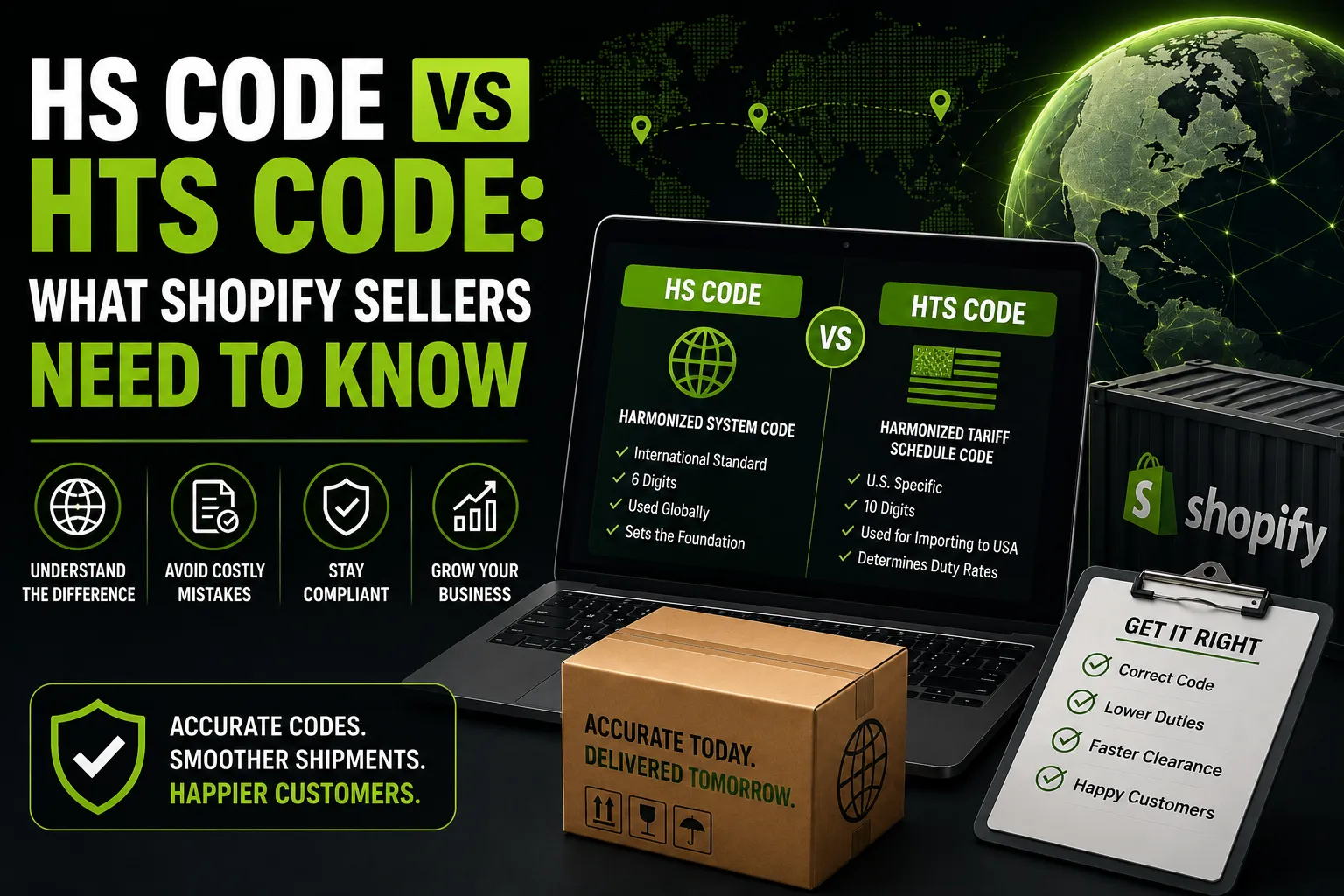
The difference between an HS code and an HTS code: an HS code is the global six-digit standard for classifying traded products, maintained by the World Customs Organization and used by nearly every country. An HTS code is the United States’ 10-digit version — the same six HS digits plus four US-specific digits that set the exact duty rate. Every HTS code contains an HS code; the reverse isn’t true.
For Shopify sellers the practical question is which one goes in your product data — and the answer is simpler than the terminology suggests. Here’s the full picture.
This is general information, not legal or customs advice.
What is an HS code?
An HS code is a six-digit number that identifies what a product is, in a format nearly every customs authority on Earth understands.
The Harmonized System is maintained by the World Customs Organization (WCO) and used by countries responsible for around 98% of international trade. The six digits are hierarchical:
- First two digits — chapter: the broad category (Chapter 61: knitted apparel; Chapter 09: coffee, tea, and spices).
- Middle two digits — heading: the product group within the chapter.
- Last two digits — subheading: the specific product type.
Example: 0902.10 is green tea in small packs — 09 (coffee/tea/spices), 02 (tea), 10 (green tea, not fermented). Those six digits mean the same thing to customs in Germany, Japan, and Brazil.
What is an HTS code?
An HTS code is the 10-digit US import classification: the six-digit HS code plus four digits the US adds to set duty rates and collect trade statistics.
The Harmonized Tariff Schedule of the United States (HTSUS) is maintained by the US International Trade Commission (USITC) and enforced at the border by Customs and Border Protection (CBP). It covers more than 11,000 ten-digit codes. The structure:
- Digits 1–6: the international HS code, unchanged.
- Digits 7–8: the US tariff-rate line — this is what actually determines the duty percentage.
- Digits 9–10: a statistical suffix used for US trade data.
Example: certified organic flavored green tea imported into the US is 0902.10.90.15 — the global HS code 0902.10, then US-specific .90.15.
One more cousin worth knowing: Schedule B codes, also 10 digits, are used for goods exported from the US and maintained by the Census Bureau. Imports use HTS; US exports use Schedule B; both are built on HS.
HS code vs HTS code: the comparison
| HS code | HTS code | |
|---|---|---|
| Length | 6 digits | 10 digits |
| Scope | Global — used by nearly every country | US imports only |
| Maintained by | World Customs Organization | US International Trade Commission |
| Purpose | Identify the product category | Set the exact US duty rate + statistics |
| Relationship | The foundation | HS code + 4 US-specific digits |
Other countries do the same thing the US does: the EU extends HS codes into 8-digit CN codes (10 for imports via TARIC), the UK has its own tariff, and so on. “HTS” specifically means the US schedule.
Which one does Shopify need?
Shopify’s HS code field takes the six-digit international code — and that’s enough for most sellers. You can optionally extend it with country-specific digits for markets that need finer classification.
On any product page (Shipping section), you enter the HS code per variant; start typing a description and Shopify suggests codes. If you want country-level precision — say, the full 10-digit HTS for US-bound orders — Shopify supports country-specific HS codes: the standard six digits plus the destination’s additional digits, added per country or region.
When is the longer code worth it? When duty rates within your product’s six-digit subheading vary at the US tariff-line level, the 10-digit code makes checkout duty estimates more precise. If everything under your subheading carries the same rate, six digits do the job.
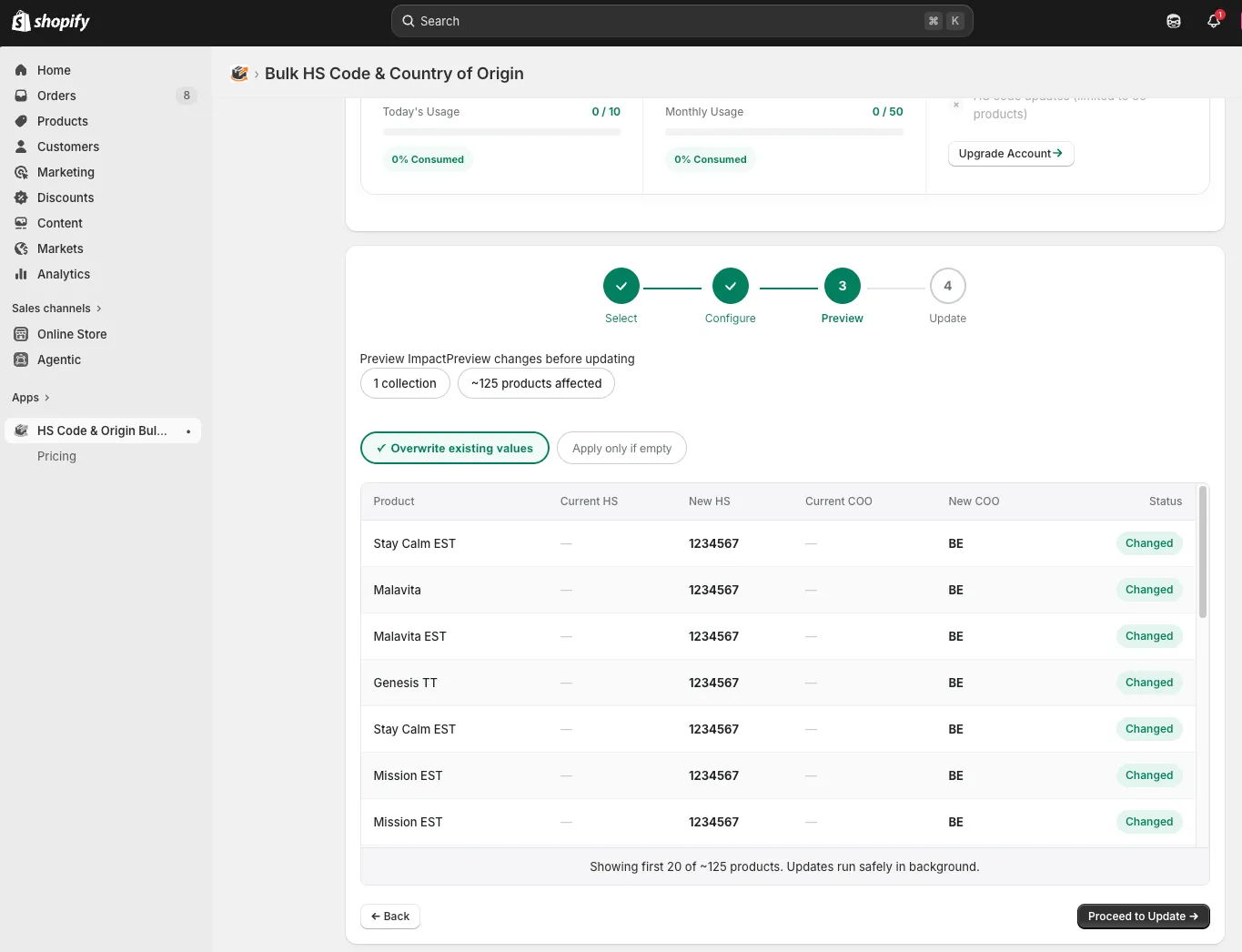
Whichever depth you choose, the codes only help if they’re on every product. Adding them one by one across a catalog takes hours — How to Bulk Add HS Codes to Shopify Products (3 Methods Compared) walks through all three bulk methods, and HS Code & Origin Bulk Editor applies codes by collection, vendor, or product type in a few clicks, directly in the Shopify admin.
Where do you find your HS and HTS codes?
For US-bound goods, the official source is the USITC search tool at hts.usitc.gov — free, current, and authoritative.
Search a plain-language keyword (“candle,” “leather bag”), then narrow from chapter to heading to subheading. The first six digits of the result are your international HS code; the full ten digits are your HTS code. Other useful routes: Shopify’s built-in code suggestions on the product page, your carrier’s lookup tools (DHL, FedEx), and classification services like Avalara or Zonos.
For mixed-material products, kits, or anything that could fall into multiple categories, treat automated results as a starting point — misclassification is the importer’s liability. A licensed customs broker, or a binding ruling from CBP, settles ambiguous cases for good.
What happens if you get the code wrong?
Wrong codes cost money in both directions: overpay with a too-high classification, or face delays, reassessment, and penalties with a too-low one.
US law requires “reasonable care” in classification. Honest mistakes typically mean held shipments and corrected duty bills; patterns of misclassification can bring civil penalties of up to several times the duties lost, and deliberate misclassification has produced multimillion-dollar settlements. The classic traps: picking the cheaper code instead of the correct one, classifying by the wrong material, and copy-pasting codes from old invoices without checking the current schedule.
The good news: for a typical Shopify catalog, classification is mostly repetitive — products in the same collection share a code. Get one right, apply it to the group, and keep a note of how you classified it. Start with the full setup guide: HS Codes & Country of Origin for Shopify: The Complete 2026 Compliance Guide.
FAQ
Are HS codes and HTS codes the same thing?
No. An HS code is the global six-digit product classification used by nearly every country. An HTS code is the 10-digit US import version — the same six digits plus four US-specific digits that set the duty rate. The first six digits of any HTS code are an HS code.
Do I use an HS code or HTS code in Shopify?
Enter the six-digit HS code in Shopify’s HS code field — that’s the international standard the field expects. Optionally, add country-specific codes (like the full 10-digit US HTS) per destination market for more precise duty estimates.
What is a Schedule B code?
A 10-digit code for goods exported from the US, maintained by the US Census Bureau and built on the same six-digit HS foundation. Imports into the US use HTS codes; exports out of the US use Schedule B.
Where do I look up an HTS code?
The official source is the USITC’s free search tool at hts.usitc.gov. Search by keyword, narrow to the 10-digit code, and check the duty rate columns. For ambiguous products, consult a licensed customs broker or request a binding ruling from CBP.
Do HS codes change?
Yes. The WCO revises the Harmonized System roughly every five years, and the US updates the HTS multiple times a year as tariffs and trade agreements shift. Review your classifications periodically — a code that was right two years ago may have moved.
How do I add HS codes to many Shopify products at once?
Use Shopify’s bulk editor for small batches, the inventory CSV for spreadsheet-style updates, or HS Code & Origin Bulk Editor to apply codes by collection, vendor, or product type in a few clicks with no CSV round-trip.
This is general information, not legal or customs advice. Customs rules change — verify current requirements with official sources or a licensed customs broker.
 Sharfaraz Ahmed


